
20 Dec 2016, 11:39 am
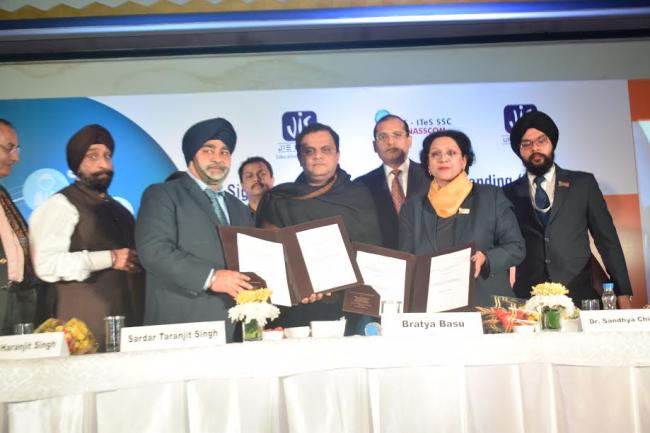
JIS Group, considered to be one of the largest educational groups in the country has been chosen by NASSCOM for such an initiative for the first time in Eastern India , keeping in view the demand and requirement of IT & ITeS Industries in the coming future.
The academic programs developed by SSC NASSCOM included in this endeavor are ‘Foundation Skills in Information Technology’ (FSIT), as well as Qualification Pack (Job Role) based programs covering ‘Product Design Engineer –Mechanical’ (SSC/Q4201), ‘Associate - Transactional F&A’ (SSC/Q2301), ‘Associate – Analytics’ (SSC/Q2101), ‘Analyst Application Security’ (SSC/Q903) and ‘Security Analyst’ (SSC/Q0901).
.jpg) The strategic alliance with JIS University & JIS Group aims to offer these programs to Engineering and Management students either as an as an elective course to an existing course, or as an add-on program with the goal to enhance their employability skills.
The strategic alliance with JIS University & JIS Group aims to offer these programs to Engineering and Management students either as an as an elective course to an existing course, or as an add-on program with the goal to enhance their employability skills.
This initiative is expected to be rolled out to students at JIS colleges. Industry leaders who have helped to design the courses themselves say that the SSC NASSCOM programs are essential to make the students industry-ready and employable.
.jpg) SSC NASSCOM will facilitate the Train-the-Trainer (TTT) program for university or college faculty members involved in this project, aimed at providing a holistic view of the essential pedagogy and principles fundamental to the course that will be beneficial for the students to become industry-ready and employable.
SSC NASSCOM will facilitate the Train-the-Trainer (TTT) program for university or college faculty members involved in this project, aimed at providing a holistic view of the essential pedagogy and principles fundamental to the course that will be beneficial for the students to become industry-ready and employable.
Under this MoU, SSC NASSCOM will provide guidelines and recommendations related to program particulars, such as faculty selection, student selection, infrastructure for training, and evaluation. Post successful completion of the trainings SSC NASSCOM,as the awarding body shall also participate in the assessment &certification process. The QP certification will be conjunction with the JIS University, Ministry of Skill Development and Entrepreneurship (MSDE) and NSDC (National Skills Development Corporation).
.jpg) On the occasion Dr. Sandhya Chintala, Executive Director, SSC NASSCOM & Vice President, NASSCOM said, “Collaborating with academia will contribute to the mission of developing a skills ready workforce for the IT-BPM industry. According to the National Skills Mission, by 2022 about 350 million professionals would need to be skilled to become employable. To achieve this target, a structured approach involving all stakeholders is imperative. The skills gap needs to be addressed through comprehensive efforts at various levels, catering to different needs of the society and the industry at large.”
On the occasion Dr. Sandhya Chintala, Executive Director, SSC NASSCOM & Vice President, NASSCOM said, “Collaborating with academia will contribute to the mission of developing a skills ready workforce for the IT-BPM industry. According to the National Skills Mission, by 2022 about 350 million professionals would need to be skilled to become employable. To achieve this target, a structured approach involving all stakeholders is imperative. The skills gap needs to be addressed through comprehensive efforts at various levels, catering to different needs of the society and the industry at large.”
- Sona College of Technology's 25th graduation day: 1,325 students receive BE, BTech, ME, MCA, MBA and PhD degrees
- ‘We are the worst storytellers’: Suhel Seth on India’s failure to market itself at 'Kitaab' book launch
- Sona College of Technology welcomes 2,400 freshers to UG, PG programmes
- ‘Children shouldn’t carry the burden’: Social activist Sundeep Bhutoria urges Centre to enforce 10% school bag rule
- When the Body Becomes a Temple: The Ramnami Samaj's Century-Old Rebellion Now Inspires Kolkata's Durga Puja
- From Ramnami tattoos to a global app: Chaltabagan's 'Nishan' takes Durga Puja beyond Kolkata
- 66th Graduation Day: Thiagarajar Polytechnic records 100% placement for graduating batch of 692 across 11 disciplines
- 66th Graduation Day: Thiagarajar Polytechnic records 100% placement for graduating batch of 692 across 11 disciplines
- Three outstanding PhD scholars to receive Rs 1 lakh a year for three years from Valliappa Foundation
- Chaltabagan Durga Puja 2026: Khuti Puja marks new beginning amid Bengal’s political change



IndiGo has announced a new daily nonstop service between Mumbai and Hanoi, beginning October 25, 2026. The new route will expand the airline’s international network and improve connectivity with Vietnam’s capital, giving passengers more options and flexibility for travel between India and Vietnam.

Aviation major Emirates is taking its award-winning Premium Economy experience a step further with the launch of what it describes as the world’s first electrically powered Premium Economy seat, featuring a full-height adjustable privacy screen between every seat.

Air India and Drukair, Royal Bhutan Airlines, have entered into an interline partnership to enhance travel convenience and strengthen network connectivity between India, Bhutan, and destinations beyond.