
NITN | @notintownlive | 25 Oct 2025, 05:52 am
 Global Warming
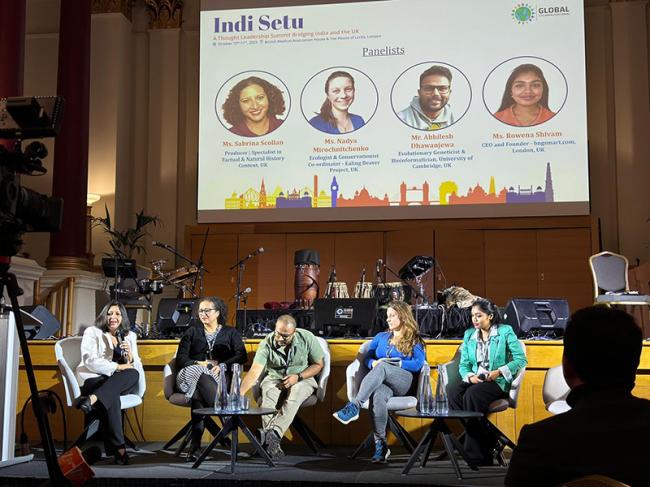
Rewilding is about rebuilding our bond with nature before time runs out, concur panelists at Indi Setu London Summit. Photo: IBNS
London: Can rewilding — in cities, in the wild, and in our stories — become a real strategy for conserving biodiversity as the planet heats up?
A thought-provoking panel on the topic “Wildlife on the brink — Can we rewild a warming world?” at the Indi Setu thought-leadership summit in London this October explored that question with urgency and optimism.
Moderated by Subhra Priyadarshini, Chief Editor of Nature India, the session brought together filmmaker Sabrina Scollan, urban ecologist Nadya Mirochnitchenko, evolutionary geneticist Abhilesh Dhawanjewar, and sustainability academic Rowena Shivam — four voices at the crossroads of science, policy, and storytelling.
Restoring Nature’s Missing Pieces
Mirochnitchenko, who works on reintroducing beavers and harvest mice to London’s wetlands, said rewilding is fundamentally about restoring ecological function.
She noted that beavers have been absent from London for nearly four centuries. Their return is already reshaping how the city manages flood risk and biodiversity. But, she cautioned, “boutique success stories” will not save wildlife unless they scale up with long-term policy support and monitoring.
Dhawanjewar added that genetics must guide rewilding decisions. “We can’t assume ecosystems will simply snap back,” he said — especially with climate change shifting habitats faster than species can adapt. The debate over assisted migration — helping species move to new climates — is now unavoidable.
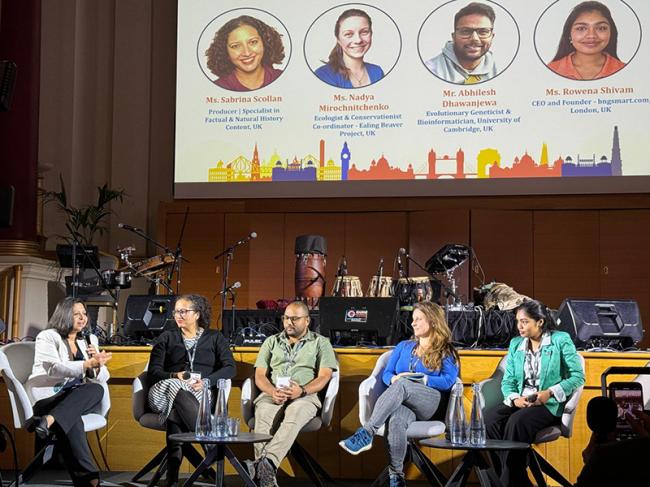 Subhra Priyadarshini, Chief Editor of Nature India, moderates the session participated by filmmaker Sabrina Scollan, urban ecologist Nadya Mirochnitchenko, evolutionary geneticist Abhilesh Dhawanjewar, and sustainability academic Rowena Shivam. Photo: IBNS
Rewilding Without the Fairytale
Scollan warned that storytelling often oversimplifies rewilding as nature returning to a perfect past. But true rewilding, she said, is messy, political, and deeply human.
She urged creators to spotlight community voices and link wildlife stories to real-world governance — whether about beavers in London or tigers in India — because coexistence begins where animals and people meet.
The panel offered a media “checklist”:
-
Don’t romanticize — show complexity
-
Centre local and Indigenous perspectives
-
Tie stories to policy and action
From Pilot Projects to Policy
Shivam stressed that rewilding succeeds only when communities have ownership and financial backing. Enthusiasm must be matched with clear policy frameworks, integration with urban design, and climate adaptation planning.
Tools such as biodiversity credits and community monitoring can help efforts move from isolated pilots into mainstream governance, she added.
Global Lessons Across Landscapes
The conversation frequently connected London and India:
-
Community-led rewilding in the UK can learn from India’s experience managing tigers, elephants, and leopards alongside people.
-
India’s large-landscape conservation models can inspire cities worldwide to build connected habitat networks, not fragmented green islands.
A Call to Re-Imagine Our Role
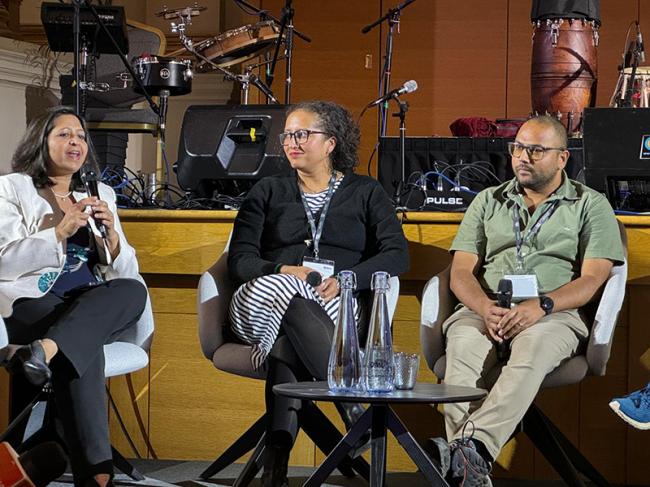
The panel concluded that rewilding must leap from trend to systemic strategy — one that blends science, narrative, and policy to reshape how humans live with nature.
Individuals, they said, can support or volunteer with local ecology groups, advocate for wildlife-inclusive urban planning, use storytelling to document urban species, and hold leaders accountable for their biodiversity commitments.
The session ended with a healthy debate and a strong message: rewilding is not just about bringing wildlife back — it’s about redesigning our relationship with the planet before time runs out.
About Indi Setu London Summit
India-UK cultural diplomacy took center stage at the inaugural Indi Setu Summit in London on Oct 10-11 at the two-day thought leadership event designed to build a new cultural and intellectual bridge, sparking dialogue and collaboration between professionals across borders. Conceptualized by Dr. Amit Ghose (Consultant Urologist & Founding Director, Global Collaboration Forum), the summit featured distinguished participants from different walks of life.
- Manicktala Chaltabagan Lohapatty Durga Puja Committee wins numerous Awards as ‘Nishan’ theme captures hearts
- Bengal Guv R. N. Ravi inaugurates Chaltabagan Lohapatty Durga Puja’s 84th edition ‘Nishan — The Mark’
- Sundeep Bhutoria brings Bengal’s Mahalaya to the nation in Hindi – Mahishasur Mardini ki Gatha
- VeeCycle Works Signs MoU with AP Govt for Rs 150 Cr Recycling Project in Visakhapatnam
- Kolkata culturist Sundeep Bhutoria inaugurates India National Stand at Frankfurt Book Fair 2026
- Where governments stop, institutions begin: Culture Minister Shekhawat salutes Prabha Khaitan Foundation
- National Award-winning ‘Ramnami’ puts spotlight on community behind Chaltabagan’s ‘Nishan’ theme
- Thiagarajar Polytechnic College receives Education Excellence Award for the fifth time
- Sona College of Technology's 25th graduation day: 1,325 students receive BE, BTech, ME, MCA, MBA and PhD degrees
- ‘We are the worst storytellers’: Suhel Seth on India’s failure to market itself at 'Kitaab' book launch


Air India will launch non-stop flights between Delhi and Osaka’s Kansai International Airport on 2 February 2027, becoming the only airline to operate on the route. The airline will run four flights a week between the Indian capital and Osaka, Japan’s second-largest metropolitan area, using Boeing 787-8 aircraft.
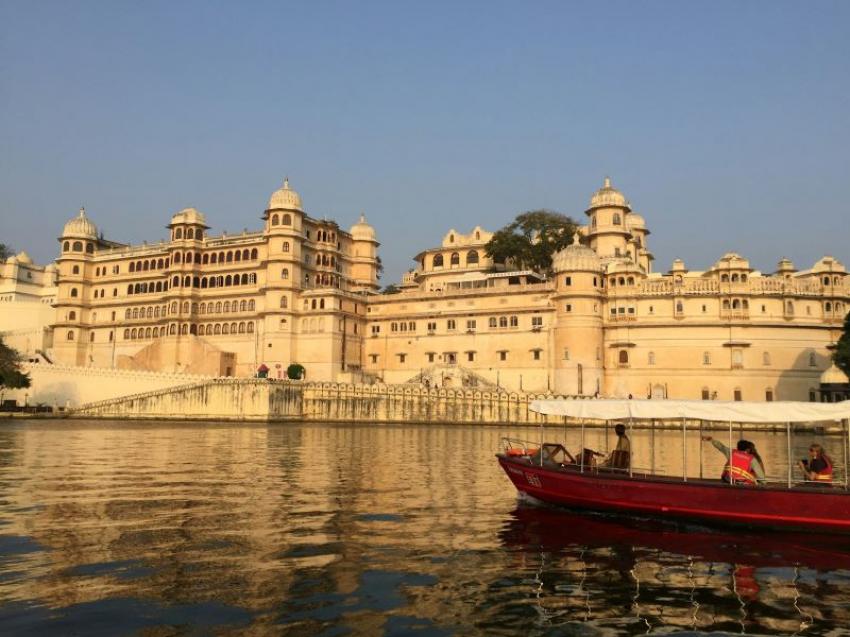
IndiGo will introduce daily non-stop flights to Udaipur from Noida International Airport and Navi Mumbai International Airport, starting October 25 and November 15, 2026 respectively.

Etihad Airways and Nigerian carrier Ibom Air have signed an interline agreement that will allow passengers travelling with Etihad to connect beyond Lagos and Accra to five cities in Nigeria on a single ticket.